












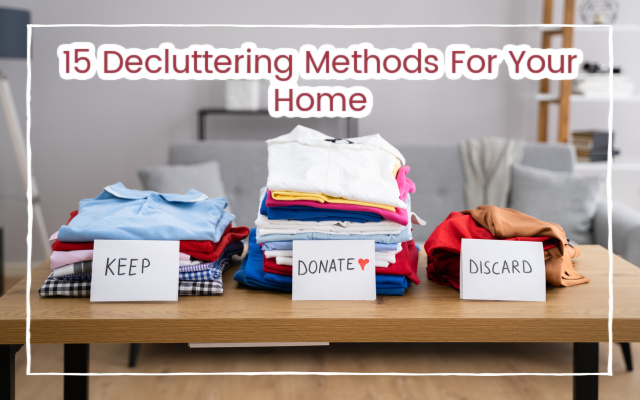
I like to be organised. I think it’s in my DNA. But keeping on top of clutter in a family home is difficult. There are a lot of trends and methods for decluttering. Whether you are tackling an area, are short on time, or you need a challenge to get you motivated when the task can seem overwhelming. I’ve pulled together 15 decluttering methods, so you can see which ones could work for you to bring a sense of calm to hectic family life.

Area Based Decluttering Methods:
When you have an area to tackle, such as your wardrobe, or the kids toys, or maybe an entire room, these methods can really help to manage the task and keep you focused.
1) The Home Edit Method
Clea and Joanna from The Home Edit define 4 key stages for decluttering your home and staying organised.
- Edit – Get rid of unwanted things.
- Categorise – Group items into categories.
- Contain – Contain the items in each category within the space you have, utilising storage solutions such as baskets and tubs.
- Maintain – Keep the area tidy and organised.
Breaking things down into smaller tasks always makes the job seem less daunting and more manageable.
2) Tidy Toss Method
Tidy toss is a great way to avoid unnecessary organisation. Tossing smaller items into baskets keeps them tidy, without having to be Instagram worthy. For example baskets with scarves, swim stuff, or belts. Tossing these items into a basket is easier and a much more realistic way to keep on top of things.
I am happy to chuck the kids Lego into a tub, but am I that Mum who organises the bricks by colour? No. Well, actually I totally would be if it weren’t for the fact that it would take approximately 4 minutes and 25 seconds to be messed up again. Choose your organisation battles!
3) Konmarie Method
If you haven’t heard of Marie Kondo you must have been living under a rock. Her tidying method consists of tackling the home in a particular order; clothes, books, paper, miscellaneous items, and sentimental items. If the item sparks joy, or serves a purpose, keep it. If not, get rid.
When you are not decluttering the whole house this method can seem redundant, however it is worthwhile thinking of things in categories. We had a draw in each room with charging cables and plugs. After a declutter which involved getting all the cables from around the house, each room now has one charging lead plugged in, and the spares are together in one drawer, rather than scattered all over the house.
4) One Touch Rule Method
Placing items in one place, and refrain from moving from spot to spot. Everything has a home and doesn’t need to be touched more than once. For example, kicking your shoes off at the door and leaving them there until Mum comes and puts them in the shoe cupboard! I feel this method may involve the re-training of the entire household. It can help you to identify hot spots where clutter gathers and you could use a catchall basket to make these areas tidier.
5) Four Box Method
The four box method is a great way to keep you on track with your decluttering. Whether it’s the toy box, or the spare room, the system works and stops you from keeping things for the sake of it. Simply sort your items into the four boxes:
- Rubbish
- Donate
- Keep
- Relocate

Challenge Based Decluttering Methods:
If you are someone that find decluttering really daunting and put the job off, challenge based methods might help you get the job done.
6) Scavenger Hunt Challenge
Create a scavenger list and go find! The list can be as long as you want and as creative as you want. Once you find all the items throw them out and you have decluttered some stuff!
An example scavenger list:
- A charging lead for a phone you no longer have
- A hobby item for a hobby you no longer do
- A book you have a duplicate copy of or in another format
- An out of date diary or calendar
- A make-up item that is more than a year old
- A piece of clothing that is too small
- A broken item
- An unwanted gift
- An expired item from the food cupboard
- A scrap of paper
7) 30 Day Minimalist Challenge
Not for the faint hearted, this challenge involves removing unwanted and unnecessary items from your home. On day 1 you remove 1 item, on day 2 you remove 2 items, and so on, until day 30 when you may require a skip to remove 30 items! At the end of the challenge you will have removed 465 items. Will you have anything left?
8) 10:10:10 Challenge
This challenge could also fall into the time based methods. It involves spending 10 minutes each in 10 different areas and removing 10 items from each. So after an hour and 40 minutes you will have removed 100 bits of clutter. This one is great if you need to break tasks up around kids nap-times. You could get the whole family involved and reduce the time it takes.
9) 12:12:12 Challenge
This method was created by Joshua Becker and is a challenge based declutter for when you find things overwhelming, and need to break things down into more manageable chunks. Simply find 12 things for each category:
- 12 Things to tidy (Putting things back in their rightful place)
- 12 Things to donate
- 12 things to throw out
10) 52 Week Challenge
There are numerous websites that offer decluttering challenges and a community to go along with it. One example is the 52 week challenge. It’s free to sign up, and each week you receive an email with an area to tackle in your home. The first week is kitchen counters and sink.
I think this is great if you find it hard to get motivated, or don’t know where to start. However I do think that before you are halfway through the challenge you will find some of the first few areas are cluttered again. So you might feel demotivated. I think it’s a myth to say we declutter your homes and they stay that way. Especially in a family home. It’s an ongoing job. A more realistic approach might be this 30 day declutter challenge.

Time Based Decluttering Methods:
Time based decluttering methods are great for fitting into your life so that decluttering is an achievable task centred around what time you have. These can also be great when you have a time based occasion to declutter for such as the Christmas declutter!
11) One Hour Method
Whether it’s one hour a day, or one hour a week, schedule an uninterrupted hour to tackle an area of your home. If you finish it in less than an hour move onto the next area until your hour is up. If you don’t finish it, leave it until your next scheduled hour. Making time to do it is the first step to progress.
12) 10 Minute Method
Dedicate 10 minutes a day to decluttering. It’s amazing how much you can achieve in 10 minutes and how easy it is to keep on top of things this way. You can get the whole family involved too. Here are a few things easily achieved in 10 minutes:
- Clear off kitchen counters
- Tidy clutter hot-spots
- Sort the junk drawer
- Tidy the shoe cupbord
- Sort paperwork
- Tidy Bedside Table
- Put toys away
- Sort sock drawer
- Clean out the fridge
- Tidy a kitchen cupbaord
- Tidy Bathroom Storage
- Sort out make-up
- Tidy a book shelf
- Empty kids school bags
13) Basket Method
When you are short on time but need the house to look tidy, deploy the basket method. Simply go from room to room filling the basket with items that are not where they belong or that need to be discarded. Hide the basket and the house will instantly be tidied. Once a week set aside some time to go through the basket and return things to their rightful place or throw away.
14) The Pomodoro Method
Designed to keep you on task and focused, the Pomodoro technique involves setting a timer for 25 minutes for your task. At the end of the 25 minutes take a 5 minute break, then reset the timer and go again for another 25 minutes. Continue this until the area you are decluttering is finished. If you have a large task to do breaking it into 25 minute sessions can make it seem less daunting. Especially if you get a cup of tea and a biscuit in your 5 minute break!
15) Sunday Reset
Set aside time on a Sunday to set yourself up for the week ahead. Whether that’s by doing chores, meal prep for the week, planning your diary, or doing some self care. Maybe it’s all of the above. Find a Sunday routine that works for you in making you feel prepared and organised for the week ahead.

Tips for decluttering
- 20/20 Rule
We all have things that we don’t know if we should keep, or we keep just in case. These things usually end up in the junk drawer, or as I call it, the place where things go to die. The 20/20 rule works well for these items. If you can’t replace in under 20 minutes and for under £20, keep it. If you can, chuck it out.
- Outside In
Where should you start? If you struggle with decluttering, one theory is to start from the outside in. Do the garden first, then the hallway, moving onto the living room, kitchen, and dining room before tackling the bedrooms and bathrooms. The theory being that you see what you have achieved the moment you get home and it gives you the motivation to carry on.
- Decluttering checklist.
I don’t need an excuse to make a list. Making a list of the the areas / items you want to tackle enables you to schedule time to do it, and makes the task more manageable. You also get that really satisfied feeling when you can tick an item off.
- 50/50 Storage Rule
I’m not sure how practical this tip is, especially when it comes to toys, but some organisation experts say you should only fill 50% of your cupboard space. This leaves 50% for new items and ensures there is always a space for anything coming into your home. Once the cupboard is at full capacity and no longer easy to get things from, it’s time to declutter again.
Conclusion
The easiest way to declutter and stay on top of it is finding a method that works for you, and suits the way you work. Knowing whether you prefer to tackle things in bite sized chunks, or go in at the deep end. Try to make a decluttering a daily habit so it remains a short job. But if in doubt try the morbidly titled Swedish Death Cleaning: AKA Get rid of all the crap you wouldn’t want anyone else to find if you were to die!
You may also like…



Leave a Reply